Cadence Pacers · Guide
The Pacer Guide
Everything you need to know to pace with Cadence — the role, the runs, the check-ins and the Miles.
Cadence turns 4 soon. The community has grown a lot since the very first runs, and a big part of that is thanks to the generations of pacers who came before you. Pacers do more than hold a pace three days a week and pull the groups on Thursday, they’re the glue of this community, the people everyone else gathers around.
If you’re reading this, you’re part of the pacing team for 2026–2027.
Congratulations, and welcome.
The pacing team
We deliberately keep the pacing team small. A small team means everyone actually knows each other, the vibe stays great, and being a pacer keeps meaning something.
The flip side: with fewer of us, every run needs to be covered. So we count on each pacer to show up regularly — not just for the runners, but for each other. (What “regularly” means in practice is in Showing up below.)
Time together
The pacing team isn’t just about covering runs. Drinks after the Sunday run, a dinner, a race trip, a random Tuesday idea — if you feel like organising something with other pacers, go for it. Proposing things isn’t just allowed, it’s encouraged.
Two WhatsApp groups keep it all flowing:
- –CORE Pacers 🫶 — pure operations: run coverage, replacements, logistics.
- –pacers ⚡️ — for the fun. Everyone who has ever paced with Cadence is in there, from day one until now.
Pacing a run
Pacing a run comes down to three things:
- Hold the pace. The group signed up for a specific pace — your job is to make sure it’s respected.
- Own the route. Know the itinerary (or invent it, your call), keep the group together.
- Make everyone feel welcome. Chat with everyone, not just your friends. New faces first as that’s how they become regulars (and because we love everyone to feel welcome).
And above everything else: safety first. Watch the traffic, respect the lights, regroup at crossings. We care about our community.
What if someone can’t keep up?
First, check they’re okay. Then walk them through the rest of the route — often there’s a shortcut that lets them rejoin the group further along. As a last resort, let them know they can finish at their own pace and that we’ll all meet at the Belga after the run. Nobody gets dropped without a plan.
Pacing on the track
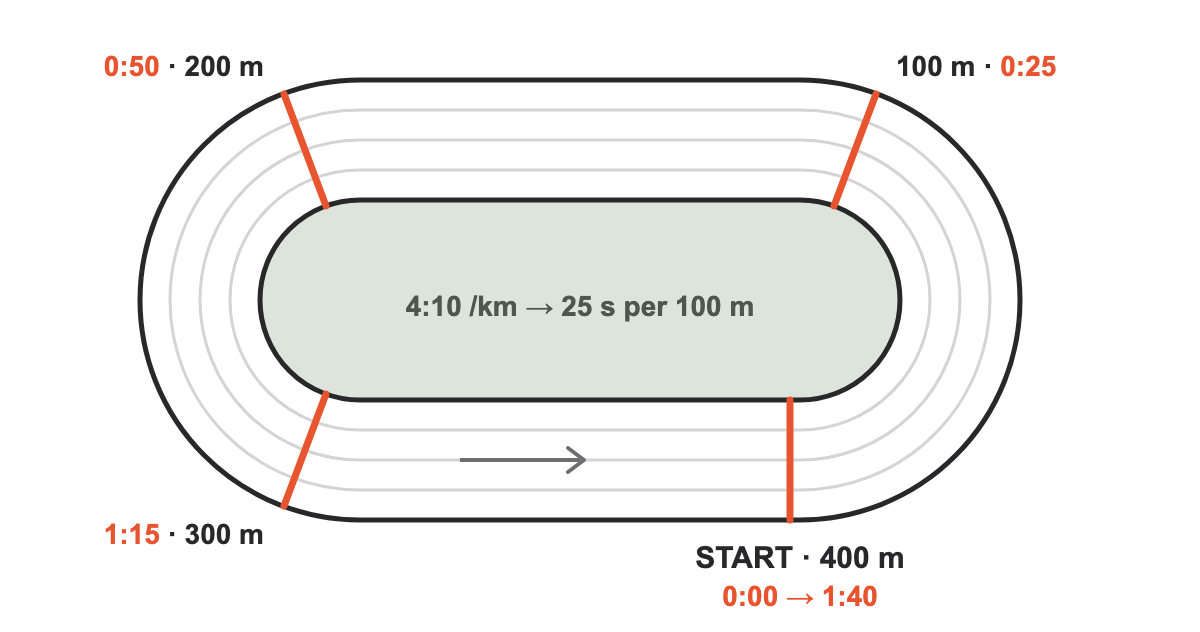
Track pacing (Thursday’s LANES session) is more technical: intervals only work if the pace is exact. The trick is to stop thinking in min/km and start thinking in elapsed time.
A track is 4 × 100 m. When the session program comes out:
- Convert the target pace into a time per 100 m before the session.
- Check the clock at every 100 m mark during the effort.
- Adjust gently. Ahead of schedule? Ease off. Behind? Pick it up — smoothly, not in one surge.
Showing up
Showing up works as a team. Together, we go for 6 paced runs out of 16 a month per pacer as that’s what it takes to cover every group every week, and it’s how pacers actually get to spend time together.
That 6-run mark is the baseline for everyone — and it lives on the season, not the calendar month. Away for a few weeks in July? Pace a bit more in August and you’re right back on track. No problem!
Check in before every run you pace: NFC tag on Tuesday, Friday and Sunday, QR scan on Thursday. On Thursdays, one pacer takes the checker role and scans everyone’s subscription before the session. Checkers, don’t forget to have another pacer scan you too 🙂
Your numbers live in the Pacing team tab of the app: your own stats, plus the team’s overall number, so everyone can see where we stand. And if the team at one point slips below the mark, we’ll simply look at the stats together and check in with those who no longer have the time — maybe they’d rather pass their spot to someone who can’t wait to take it.
No hard feelings, ever. Priorities shift. Work, family, injuries, a new hobby. Not being as available as last year is completely normal. The only thing we ask is to talk about it, so the team keeps working for everyone.
Weekly polls
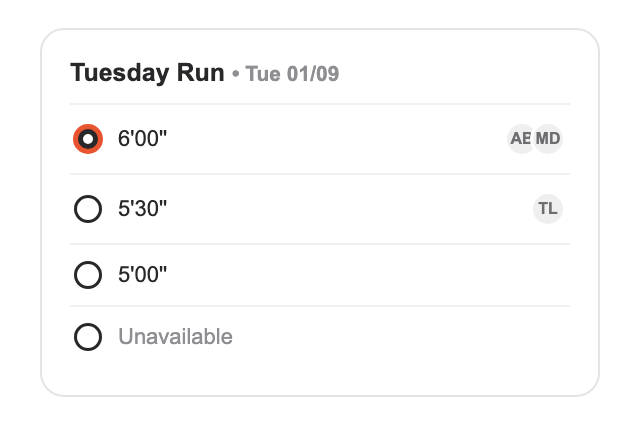
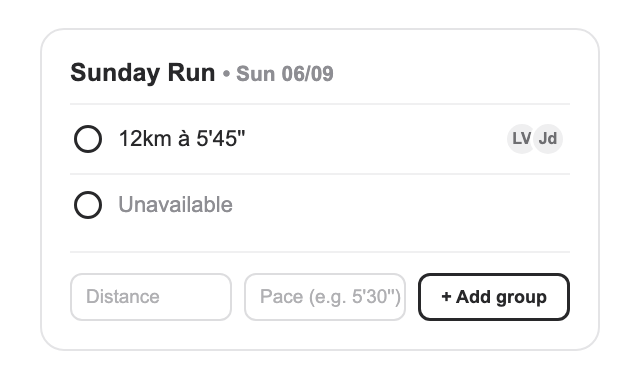
All run planning happens in the app: the Pacing team tab has one poll per run, and it replaces the WhatsApp polls entirely (sweet no?).
Fresh polls open every Sunday evening for the week ahead (you’ll get a notification), and the Pacing team tile shows a badge while you still have polls to answer (so it’s easy to remember). Fill yours in early: tick the group you’ll pace for each run, or Unavailable if you can’t make it, so captains can see at a glance which runs still need someone.
The Sunday run is the “open” one: propose a pace and a distance based on what you feel like doing, and see who joins.
Make sure you answer all polls, even if you are not available so the captains knows who they can count on!
The uniform
Every pacer gets a pacer uniform (t-shirt), so the rest of the community can spot at a glance who’s part of the team. Someone new shows up, doesn’t know anyone, doesn’t know where to go? The uniform tells them exactly who to ask.
As a pacer, you’re always a little bit on stage, you represent Cadence. So whenever you join a Cadence run, wear your uniform. We don’t have extra’s so don’t lose it 🙂
Handling check-ins at runs and events
Tuesday, Friday and Sunday — runners check themselves in: they hold their phone near the Cadence NFC sticker and tap the link that opens. That’s it. Check-in is automatic and only possible in a set time window before the run.
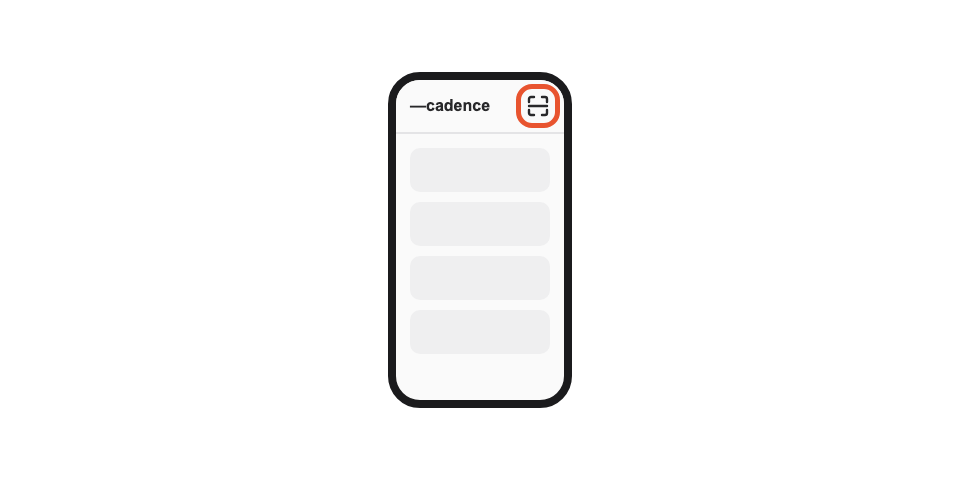
Thursday — since LANES subscriptions plans are checked, one of the pacers on site scans everyone present. One scan does both jobs at once: it verifies the subscription is valid and credits the runner’s Miles. The scanner sits in the top-right corner of the app when you have pacer status.
Special events with a ticket (paid or free) — one or two pacers are in charge of ticket control at the start.
Miles for pacers
Pacing is volunteering. You do it because you want to help build Cadence. But partners regularly send gifts our way (shoes, apparel, sometimes trips), and it matters to us that pacers get first access to them.
- Pacers earn 10 Miles per run — more than participants.
- Pacers have their own leaderboard, separate from the members’ one.
- When an opportunity lands, we look at Miles first — the pacers who give the most get the most back (simple, basique).
The final say on gifts and perks stays with Max and Antoine.
When you leave the team, you become a regular member again and your Miles are divided by two so the members’ leaderboard stays fair for everyone.
Pacer perks
Being a pacer comes with a few perks, on top of the uniform and the gifts:
- Absolute priority for events. When registrations open, pacers go first.
- Better prices on paid events. Whenever we can, we offer pacers a lower price than regular and CORE members.
- Your LANES subscription is on us. And Thursday’s track session is yours to enjoy as a runner too — you don’t have to be there as a pacer to come run.
Captains
Captains are pacers who want to take it one step further and look after one weekly run. It’s not about being there every single time, it’s about making sure the run always has the pacers it needs, setting the tone, keeping people motivated. Being the face of that run.
There’s one captain on Tuesday, one on Thursday, three on Friday and two on Sunday. For that extra layer of care, captains earn bonus Miles every week.